EXAMINING EPHESIANS
2:13-14.
WHERE IS THE ENMITY, WHAT IS ABOLISHED, AND WHAT IS THE MIDDLE WALL OF SEPARATION?
WHERE IS THE ENMITY, WHAT IS ABOLISHED, AND WHAT IS THE MIDDLE WALL OF SEPARATION?
Please turn to Ephesians 2:13-14:
"For He himself is our
peace, who has made both one, and
has broken down the middle wall of
separation, having abolished in His flesh the enmity,
that is, the law
of commandments
contained in ordinances, so as to create in Himself one new man from the two,
thus making
peace, and that he might reconcile them both to
God in one body through the cross, thereby
putting to
death the enmity."
Like
many others who may be reading this, I too at one time thought the middle wall
of separation was the wall which served to separate the inner Temple from the
court of the Gentiles. I too believed that; because, it was what I had been
taught by pastors as you probably have been. Here some photos may help you
visualize what we have been taught was the "middle wall of
separation" which served to keep Gentiles (Goyim) out of the temple.

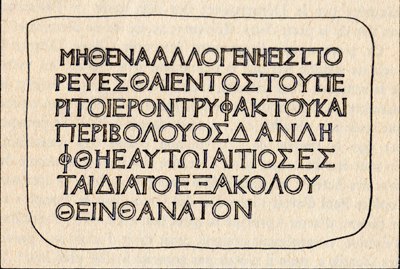
What the inscription says is the following:
"No stranger is to enter within the balustrade
around the Temple and its enclosure.
Whoever is caught will be responsible
for his own death.
According to the Mishnah (Middot II, 3) this 1.3m-long barrier was called the "soreg."

The Court of the Gentiles was the area between the "soreg" and the outer walls of the early square temple mount. The fact YHWH wants them to draw near; however, they were to be kept separate for a REASON.


The reference to the "middle wall of separation" as being the "soreg" or "balustrade" in the Temple is actually incorrect. We will deal with this in another chapter entitled "The Middle Wall of Separation." Be sure to look for it. For now let us look more at the term "enmity."
When it came to the thing that brought enmity
I had been taught it was the "law" the Torah of Moses; which Messiah
nailed to the cross "abolishing" it "in his flesh." Imagine
the frustration when I discovered that I couldn't have been more off base and
misled. For some of you grappling with the idea that the Torah of Moses wasn't
done away with may be a difficult pill for you to swallow. I recognize it might
cause you to question what you had been taught or heard. When the truth hits
you like a lightning bolt; please don't bash your pastor because he misled you
out of ignorance. Pray for them; they have souls; and, need to see the truth
just as badly as we do. In some cases they have walked away from lucrative
careers to serve in ministry because they felt the call of God on their lives.
Be gentle, yet firm and do your best to deliver the message in its fullness to
them. Be as long-suffering with them as Messiah has been with you and I.
Before we dive into this passage I would
like to point out the term "abolished" which in Greek is G2673 (καταργησας) katargeō
pronounced
"kat-arg-eh'-o" From G2596 and G691 means:
to be (render) entirely idle
(useless),
literally or figuratively:-
abolish, cease, cumber, deliver, destroy, do away, become
(make) of no
(none, without) effect, fail,
loose, bring (come) to nought, put away (down),
vanish
away, make void.
Although
it is a different word than is used in Matthew 5:17 when Messiah says "Do
not think that I came to destroy the Law or the Prophets, I did not come to
destroy but to fulfill;" this term "katargeo" has the effect or
operation of the term Messiah used for "destroy." This term katargeo
Strong's # G2673 appears forty-four (44) different times in the New Testament
and is used primarily to convey something that has been made void, abolished, or done away
with. Again; I would like to remind you that Messiah specifically
said NOT TO THINK he had
come to abolish the Torah or the Prophets. In fact the specific Greek term used
in Matthew 5:17 for abolish only appears four (4) times in the New Testament.
Subsequently it appears only (4) times in the LXX; one (1) time to translate a
Hebrew term that means "to
lodge or encamp" and has its root in another term that appears
twice (2) to translate a Hebrew term that means "to stop." It also appears one (1) time to
translate a Hebrew term that means "to cause to cease."
This
term "katargeo" from Ephesians
2:13-14 appears only three (3) times in the LXX of the Old Testament
and is used to translate the Hebrew term H989 (בּטל) beṭêl pronounced "bet-ale'"
and means:
to stop: - (cause, make to), cease, hinder.
to stop: - (cause, make to), cease, hinder.
We will dig more deeply into this later. However for now I am going to assert to you that Messiah was saying "I have not come to stop; or; cause to cease the law and the prophets but to consecrate them, or make them Holy." Messiah is RENEWING the Covenant; the one spoken of in Jeremiah 31:31 with the House of Judah and the House of Israel; and, is consecrating it with His own blood.
We
have already seen in other passages how it cannot
be the Law of Moses which was "abolished;" therefore, we
must diligently seek another explanation.
Whatever the identity is of the thing which is "abolished" it must:
1) contain the element of enmity; and,
2) it must be intimately connected with ordinances that are contained in decrees.
Remember, the term for "decrees" is the same root used in Colossians 2:14 "dogma;" and, as we examined earlier is NEVER used anywhere to specifically refer to the Torah of Moses or the instructions of YHWH. With that in mind I would like to pose a question for you to consider.
Are you aware of any? If we are honest with ourselves; and the text we can find examples of specific people groups with whom YHWH desired to punish because of their exceeding wickedness. Yet; we are unable to locate any instructions that require enmity towards Jews; or, Gentiles as a whole. In fact there are actually commands to the contrary! Turn with me to Leviticus 19:33-34:
"And if a stranger dwells with you
in your land, you shall
not mistreat him. The stranger
who dwells among
you shall be to you as one born among you, and
you shall love him as
yourself; for you were strangers
in the land of Egypt: I am the LORD your God."
Now turn with me to Exodus 22:21:
"You shall neither mistreat a stranger nor oppress him, for you were strangers in the land of
Egypt."
Please turn now to Exodus 23:9:
"And you shall not oppress a stranger, for you know the heart of a stranger, because you were
strangers in the
land of Egypt."
You know the drill by now Exodus 23:12:
"Six days you shall do your work, and on the seventh day you shall rest, that your ox and your
donkey may rest,
and the son of your female servant and the stranger
may be refreshed."
Again turn to Leviticus 19:9-10:
"When you reap the harvest of your land, you shall not wholly reap the corners of your field,
nor shall you gather
the gleanings of your harvest. And you shall not glean
your vineyard, nor
shall you gather every grape of
your vineyard; you shall leave them for the poor and the
stranger: I am the
LORD your God."
Now Leviticus 24:22:
"You shall have the same law for the stranger and for one from your own..."
Now Deuteronomy 1:16:
"Then I commanded your judges at that time, saying, Hear the cases between your brethren,
and judge righteously
between a man and his brother or
the stranger
who is with him."
Now Deuteronomy 5:12-14:
"Observe the Sabbath day, to keep it holy, and the LORD your God commanded you. Six days
you shall labor
and do all your work, but the seventh day is the Sabbath
of the LORD your
God. In it you shall do no work: you nor your son, nor your daughter, nor
your male
servant,
nor your female servant, nor your ox, nor your
donkey nor any of your cattle, nor your
stranger who is within your
gates, that your male servant and your
female servant may rest as
well as you."
Now Deuteronomy 10:18-19:
"He administers justice for the fatherless and the widow, and loves the stranger, giving him
food and clothing.
Therefore love the stranger,
for you were strangers
in the land of Egypt."
Now Deuteronomy 14:28-28:
"At the end of every third year you shall bring out the tithe of your produce of that year and
store it up within your
gates. And the Levite, because he has no portion nor
inheritance with
you, and the
stranger and the fatherless
and the widow who are within your gates, may
come
and eat and be satisfied, that the LORD your
God may bless you in all the work of your hand
which
you do."
We could easily continue as there are a total of 78 passages containing the term "stranger" and in the TaNaK and they are all pretty much giving us the same idea. The idea that the "stranger" was to be loved; treated fairly; and, as equally as the natural born. Messiah Himself goes on to reinforce this idea in the Gospels. Come with me as we see what Messiah says about the "stranger." Turn to Matthew 25:33-40 please:
33And He will set the sheep on His right hand, but the goats on the left. 34Then the King will
say to those on His right hand, ‘Come, you
blessed of My Father, inherit
the kingdom prepared
for you from the foundation
of the world: 35for I was hungry and you gave
Me food; I was
thirsty and you gave Me drink; I was a stranger and you
took Me in; 36I was naked and
you
clothed Me; I was sick and you visited Me; I was
in prison and you came to Me.’ 37 “Then the
righteous will answer Him,
saying, ‘Lord, when did we see You hungry and feed You,
or
thirsty and give You drink?
38 When did we see You a stranger and take You in, or naked and
clothe You?
39 Or when did we see
You sick, or in prison, and come to You?’ 40 And the
King
will answer and say to them, ‘Assuredly, I say
to you, inasmuch as you did it to one of the
least of these
My brethren, you did it to Me.’ 41 “Then He will
also say to those on the left
hand, ‘Depart from Me,
you cursed, into the everlasting fire prepared for the
devil and his
angels: 42 for I was hungry and you gave
Me no food; I was thirsty and you gave Me no drink;
43 I was a stranger
and you did not take Me in, naked
and you did not clothe Me, sick and in
prison and
you did not visit Me.’ 44 “Then they also will answer
Him, saying, ‘Lord, when did
we see You hungry
or thirsty or a stranger
or naked or sick or in prison,
and did not minister
to You?’ 45 Then He will answer
them, saying, ‘Assuredly, I say to you, inasmuch
as you did
not do it to one of the least of these,
you did not do it to Me.’ 46 And these will go away
into
everlasting punishment, but the righteous into
eternal life.”
Apparently Messiah Himself is in agreement with Torah as to how we are to treat the stranger. Turn with me to Luke 17:12-19:
11 Now it happened as He went to Jerusalem that He passed through the midst of Samaria and
Galilee. 12 Then
as He entered a certain village, there met Him ten
men who were lepers, who
stood afar off. 13 And they
lifted up their voices and said, “Jesus, Master, have
mercy on us!”
14 So when He saw them, He said to
them, “Go, show yourselves to the priests.” And so it
was
that as they went, they were cleansed. 15 And one
of them, when he saw that he was healed,
returned, and
with a loud voice glorified God, 16 and fell down on
his face at His feet, giving
Him
thanks. And he was a
Samaritan. 17 So Jesus answered and said, “Were there not ten
cleansed?
But where are the nine? 18 Were
there not any found who returned to give glory
to
God except this foreigner?”
19 And He said to him, “Arise,
go your way. Your faith has
made you well.”
In this passage the Greek term for foreigner is Strong's # G241 (ἀλλογενής) allogenēs pronounced "al-log-en-ace.'" From G243 and G1085; foreign, that is, not a Jew: - stranger. If Messiah was willing to HEAL a stranger and have mercy upon him, how then can we say it is the intention of YHWH to have enmity between those He intends to:
"...create in Himself one new man from the two, thus making peace, and that He might
reconcile them both to
God in one body through the cross, thereby putting to
death the enmity."
(Ephesians
2:15-15)
I tell you the truth there is no hostility or enmity between the natural born; or, the stranger who is brought into the fold of the people of YHWH called Israel. For before we had a relationship with Messiah we were considered Gentiles (uncircumcision) and we were called as such by those who believed they were Israel. Prior to our relationship with Messiah we were:
§
without Christ (mâshı̂yach)
§
aliens from the commonwealth
(meaning citizenship) of Israel
§
were strangers from the
covenants of promise (notice it is plural; not singluar)
§
having no hope
§
were without God (YHWH) in the world
Those things are all past. We have been brought near by the blood of Messiah. I am going to simply assert to you that you and I; by our faith in Messiah are grafted into the commonwealth of Israel. We have become fellow heirs in the promise and the covenant(s) made to Israel. If then there is no enmity contained in the Torah of Moses the instruction of YHWH where then can we find enmity being taught? I tell you the truth it is the "law of commandments contained in ordinances" which come from men and not YHWH.
The
Greek term for enmity
is Strong's # G2189 and has two forms (ἔχθρα) echthra pronounced "ekh'-thrah" and (εχθραν) echthran pronounced"
ech'-thrahn." It is
the Feminine of G2190; meaning hostility; by implication a reason for opposition:
- enmity, hatred.
It comes from G2190 (ἐχθρός) echthros
pronounced "ekh-thros'" From a primary word ἔχθω echthō (to hate); hateful (passively odious, or actively hostile); usually as a
noun, an adversary
(especially Satan): - enemy,
foe.
Taking
this term and examining where it is used in the LXX translation of the Old
Testament as well as the New Testament should help shed some light for us on
where enmity resides. This
particular term appears only six (6) times in the New Testament; however in the
LXX we see it used twelve (12) times; the first of which is in Genesis 3:15; turn there
with me if you will:
"And I will put enmity between you and the woman, and between your seed and her seed; he
shall bruise your
head, and you shall bruise His heel."
Satan has been and will continue to be a source of enmity towards the woman because the Son of the Promise would come from her. Notice also that there are two seeds; the adversary's seed; and, the seed of the woman. I will assert to you that even here we see foreshadowing of the two final congregations; one is called "blessed" and the other "cursed." The Hebrew term which is rendered "enmity" and translated into the Greek "echthra" is:
H342 (איבה) 'êybâh
which is pronounced "ay-baw.'" From H340; hostility: - enmity, hatred.
Interestingly enough the root H340 means to hate as if one from an opposite tribe and only occurs one (1) time in the TaNaK. The next time we see the term (εχθραν) in the LXX is in Numbers 35:22: Turn to verse 20 to start:
"20 If he pushes him out of hatred or, while lying in wait, hurls something at him so that he
dies, 21 or in enmity he
strikes him with his hand so that he dies, the one who
struck him shall
surely be put to death. He is a murderer.
The avenger of blood shall put the murderer to
death
when he meets him. However, if he pushes him
suddenly without enmity,
or throws anything
at him without lying
in wait, or uses a stone, by which a man
could die, throwing it without
seeing him, so that he
dies, while he was not his enemy or seeking his harm,
then the
congregation shall
judge between the manslayer
and the avenger of blood according to these
judgments."
Obviously the context here is the desire to murder, or to bring harm to the other party. Keep that in mind because I will be sharing with you later decrees of men throughout history that are examples of the type of enmity which has existed between those who have NOT followed Messiah in His footsteps even though He paved the way for them to do so. Next turn to Proverbs 26:26 for context please start in verse 24:
"24 He who hates, disguises it with his lips, and lays up deceit within himself; 25 when he
speaks kindly, do not believe
him, for there are seven abominations in his heart;
26 though his
hatred
is covered by deceit His wickedness
will be revealed before the assembly."
The one with enmity in his heart seeks to disguise it and does so deceitfully. Turn with me to Isaiah 63:10 please.
"10 But they rebelled and grieved His Holy Spirit; so He turned Himself against them as an
enemy,
and He fought
against them."
One who has enmity makes themselves an enemy of God; and, His servants by default. Please turn to Jeremiah 9:8 if you would.
"...Their tongue is an arrow shot out; it speaks deceit; one speaks peaceably to his neighbor
with his mouth, but
in his heart he lies in wait."
In the LXX it actually reads as follows:
βολὶς τιτρώσκουσα ἡ γλῶσσα αὐτῶν, δόλια τὰ ῥήματα τοῦ στόματος αὐτῶν· τῷ πλησίον
αὐτοῦ λαλεῖ εἰρηνικὰ καὶ ἐν ἑαυτῷ ἔχει τὴν ἔχθραν.
Transliterated into English in the exact word order it would read this way:
Arrow is a piercing their tongue deceitful words of their mouth; to his neighbor one speaks
peaceably, and in himself he has hatred.
The Hebrew doesn't actually use the term for hatred in this passage however it is implied. Here is what the Hebrew states:
חץH2671 an arrow שׁוחטH7819
shot out; לשׁונםH3956 Their tongue
מרמהH4820 deceit: דברH1696
it speaketh
בפיוH6310
with his mouth,
שׁלוםH7965 peaceably אתH854 to רעהוH7453 his neighbor
ידברH1696 speaketh ובקרבוH7130
but in heart
ישׂיםH7760
he layeth
ארבו׃H696 his wait.
What struck me as intriguing was when I looked at the term for "wait" to be lying in wait. Here is what I learned. H696 is (ארב) 'ôreb pronounced "o'-reb" The same as H695: - wait. Nothing sticking out like a sore thumb yet. However when you look at H695 (ארב) 'ereb pronounced "eh'-reb" From H693; ambuscade: - den, lie in wait. Then I looked at H693, are you ready?
H693 (ארב) 'ârab aw-rab' A primitive root; to lurk: - (lie in) ambush (-ment), lay (lie in) wait.
You may say that I am reaching and in a sense I am. Consider this; perhaps it is just a coincidence that the Arab people have at their core a religion (Islam) that teaches its followers to lie in wait, to ambush its enemies. It teaches enmity towards Israel who is called "my people" by God over 82 times in the Bible. I am not asserting that Arabs are THE source or cause of enmity; but rather that they are just one of the more easily identified subjects from whom it comes forth. Turn with me to Ezekiel 35:5 please:
"5 Because you have had an ancient hatred, and have shed
the blood of the children of Israel
by the power of the
sword at the time of their calamity, when their iniquity
came to an end,
6 therefore as I live says the LORD
GOD, "I will prepare you for blood, and blood shall
pursue
you; since you have not hated blood, therefore
blood shall pursue you. 7 Thus I will make
Mount
Seir most desolate, and cut off from it the one who
leaves and the one who returns.
8 And I will fill its mountains
with the slain; on your hills and in your valleys
and in all your
ravines those who are slain by the
sword shall fall. 9 I will make you perpetually desolate,
and
your cities shall be uninhabited; then you shall
know that I am the LORD."
Here
is the LXX for verse Ezekiel 35:5:
ἀντὶ τοῦ γενέσθαι σε ἐχθρὰν αἰωνίαν καὶ ἐνεκάθισας τῷ οἴκῳ Ισραηλ δόλῳ ἐν χειρὶ ἐχθρῶν
μαχαίρᾳ ἐν καιρῷ ἀδικίας ἐπ᾿ ἐσχάτῳ,
It is transliterated this way in the Apostolic Polyglot:
Because you became enemy an eternal and sat in a place against the House of Israel with
treachery, by the hand
of enemies with a sword in time of iniquity at the last.
Fascinating it is to find passages like this that shine a light on matters of prophetic significance at a time when the world is barreling rapidly towards a cataclysmic collision of cultures between Israel and her enemies. There is no option of sitting the conflict out. You must choose which side you want to belong to. One that has enmity or one that does not. Remember there are no sheep-goats in the judgment of mankind; you are either a sheep; or, a goat. Having enmity makes you an eternal enemy of the God of Abraham, Isaac and Jacob; and, Messiah's death is supposed to put that enmity to death in His flesh so that Israel and those to whom the Father calls to be grafted in among them are not hostile towards one another but rather would love each other as commanded in the Torah of Moses the instruction of YHWH. Turn with me to Ezekiel 35:10 please:
"10 Because you have said, 'These two nations and these two countries shall be mine, and
we shall possess
them,' although the LORD was there, 11 therefore
as I live,' says the LORD
God, 'I will do according
to your anger (εχθραν) and according to the envy
which you showed
in your hatred against them; and
I will make myself known among them when I judge
you.
12 Then you shall know that I am the LORD.
I have heard all you blasphemies which you
have
spoken again the mountains of Israel, saying, 'They
are desolate; they are given to us to
consume.' 13
Thus with your mouth you have boasted against Me and
multiplied your words
against Me; I have heard them."
Thus says the LORD God" 'The whole Earth will
rejoice
when I make you desolate. As you rejoiced because the
inheritance of the house of Israel was
desolate,
so I will do to you; you shall be desolate, I Mount
Seir, as well as all of Edom--all of
it! Then they shall
know that I am the LORD.'"
Can we see here that those who have enmity (rendered anger in English) toward the house of Israel are in a dangerous place? If we consider the opposite then those who do NOT have enmity; because it has been put to death in the flesh of Messiah, LOVE Israel? It goes further my friends and is inclusive of the Torah of Moses the instruction of YHWH. Turn with me now to Romans 8:6 please.
"6 For to be carnally minded is death, but to be spiritually minded is life and peace. Because
the carnal mind
is enmity
against God; for it is not
subject to the
law of God, nor can it be.
8 So then those who are in
the flesh cannot please God."
Friends, to have enmity with God means you are not "subject" to the law of God. I cannot stress the importance of this term enough. The meaning of the term "subject" is very, very, very important. I tell you the truth; it will be a matter of life or death for you to understand; or to fail to understand it. It is Strong's # G5293:
(ὑποτάσσω) hupotassō pronounced "hoop-ot-as'-so" From G5259 and G5021; to subordinate;
reflexively to obey:
- be under obedience
(obedient), put under, subdue unto, (be, make)
subject (to, unto), be (put) in subjection
(to, under), submit self unto.
Notice that this subjection is to the Law of God (YHWH). Not some false god. As the Islamic Caliphate is forming before our very eyes commanding it's followers to submit to the False Prophet named Mohammad and to obey Satan disguised as "Allah" Christians are blinded by pride and ignorance. For too long the church has taught and shouted loudly "we are not UNDER the Law but UNDER grace" all the while misunderstanding what it means to be "under" the law. When we subject ourselves or make ourselves obedient to the Torah of Moses the instructions of YHWH we act in a manner that Scripture says is righteous, clean, holy, set apart. Would you rather be set apart or carnally minded? When we walk in disobedience we do so because we either have not subjected ourselves to; or, choose not to be obedient to the Torah of Moses the instructions of YHWH the law of God. Romans even expresses that the problem was not the law itself; but our flesh because of our own weaknesses. It is not the law that was weak; but our flesh. I myself can attest to the weakness in my own flesh; and, wish that I was always walking in the Spirit 100% of the time. If I did; I would walk as my King walked in obedience to the Father and His instructions. Turn with me to James 4:4 please.
" 4 Adulterers and adulteresses! Do you not know that friendship with the world is enmity
with God? Whoever
therefore wants to be a friend of the world makes
himself an enemy of
God. 5 Or do you think that the
Scripture says in vain, 'The Spirit who dwells in us yearns
jealously'? 6 But He gives more grace. Therefore
He says: 'God resists the proud, but gives
grace
to the humble.'" 7 Therefore submit to God. Resist
the devil and he will flee from you.
Draw near to
God and He will draw near to you."
The term used here for "submit" is the SAME as the term in Romans 8:6 for "subject." James is quoting Proverbs 3:34 which begins in verse 1 with the following:
"My son, do not forget my law (TORAH), but let your heart keep my commandments
(mitzvah). For length of days
and long live and peace they will add to you."
Drawing near, subjecting, and submitting ourselves to God means that we also draw near to his commandments, statutes, judgments, and ordinances that He gave an instruction for ALL ISRAEL. Why? Because; we have become grafted into Israel by our faith. We DO NOT REPLACE HER; we are grafted into HER. Her sons and daughters become our brothers and sisters. Her mothers and fathers become our relatives. We become like Ruth when she went to Orpah and said:
"For wherever you go, I will go; and wherever you will lodge, I will lodge, your people shall
be my people, and
your God, my God. Where you die, I will die, and there will I be buried.
The LORD do so to me, and more
also, If anything but death parts you and me."
Ruth was blessed because of her faith. Just as Boaz was her kinsman redeemer so is Messiah ours. Messiah redeems us; and just as Boaz made Ruth his wife, so does Messiah come for His bride! Remember the Bride is one body; not two (2). She is of one (1) faith the same faith as Messiah; she is clean; pure; righteous; holy; without blemish. Messiah rejects the harlot; the whore of Babylon; the wanton counterfeit; the lawless; Torah-less; statute violators; commandment rejecters; judgment ignorers; ordinance breakers who make up the body of the prostitute.
Turn with me now please to Galatians 5:19:
"19 Now the works of the flesh are evident, which are: adultery, fornication, uncleanness,
lewdness, idolatry, sorcery,
hatred,
contentions, jealousies, outbursts of wrath,
selfish
ambitions, dissensions, heresies, envy, murders,
drunkenness, revelries, and the like; of which
I
tell you beforehand, just as I told you in time past, that
those who practice such things will
not inherit the kingdom
of God."
I ask
you, if we submit
ourselves to the Torah of Moses, the instructions of YHWH and obey the statutes, commandments, judgments, and ordinances
given to us; will we be find ourselves doing these things Paul says not to
practice? I tell you the truth, if we submit ourselves to and are obedient to the Torah of Moses, the instructions
of YHWH we will NOT do those things. There is and never
has been enmity in the Torah of Moses, the instructions of YHWH. This leaves us needing to ask a very important
question. If the enmity does not come from there Torah of Moses; then from
where does it come? Come with me as we examine examples of where enmity is
born.

No comments:
Post a Comment